HomeSerengeti National ParkSerengeti National Park

Serengeti National Park is undoubtedly the best-known wildlife sanctuary in the world, unequaled for its natural beauty and scientific value, it has the greatest concentration of plains game in Africa

The Serengeti National Park in Tanzania was established in 1952. It is home to the greatest wildlife spectacle on earth – the great migration of wildebeest and zebra. The resident population of lion, cheetah, elephant, giraffe, and birds is also impressive. There’s a wide variety of accommodation available, from luxury lodges to mobile camps. The park covers 5,700 sq miles, (14,763 sq km), it’s larger than Connecticut, with at most a couple hundred vehicles driving around.

The Park can be divided into 3 sections. The popular southern/central part (Seronera Valley), is what the Maasai called the “serengit”, the land of endless plains. Its classic savannah, dotted with acacias and filled with wildlife. The western corridor is marked by the Grumeti River, and has more forests and dense bush. The north, Lobo area, meets up with Kenya’s Masai Mara Reserve, is the least visited section.

Two World Heritage Sites and two Biosphere Reserves have been established within the 30,000 km² region. It’s unique ecosystem has inspired writers from Ernest Hemingway to Peter Mattheissen, filmakers like Hugo von Lawick and Alan Root as well as numerous photographers and scientists – many of which have put their works at our disposal to create this website.

The Serengeti ecosystem is one of the oldest on earth. The essential features of climate, vegetation and fauna have barely changed in the past million years. Early man himself made an appearance in Olduvai Gorge about two million years ago. Some patterns of life, death, adaptation and migration are as old as the hills themselves.

It is the migration for which Serengeti is perhaps most famous. Over a million wildebeest and about 200,000 zebras flow south from the northern hills to the southern plains for the short rains every October and November, and then swirl west and north after the long rains in April, May and June. So strong is the ancient instinct to move that no drought, gorge or crocodile infested river can hold them back.

The Wildebeest travel through a variety of parks, reserves and protected areas and through a variety of habitat. Join us to explore the different forms of vegetation and landscapes of the Serengeti ecosystem and meet some of their most fascinating inhabitants

The jewel in Ngorongoro’s crown is a deep, volcanic crater, the largest un flooded and unbroken caldera in the world. About 20kms across, 600 meters deep and 300 sq kms in area, the Ngorongoro Crater is a breathtaking natural wonder.

The Ngorongoro Crater is one of Africa’s most famous sites and is said to have the highest density of wildlife in Africa.  Sometimes described as an ‘eighth wonder of the world’, the Crater has achieved world renown, attracting an ever-increasing number of visitors each year.  You are unlikely to escape other vehicles here, but you are guaranteed great wildlife viewing in a genuinely mind-blowing environment.  There is nowhere else in Africa quite like Ngorongoro!

The Ngorongoro Crater is the world’s largest intact volcanic caldera.  Forming a spectacular bowl of about 265 square kilometres, with sides up to 600 metres deep; it is home to approximately 30,000 animals at any one time.  The Crater rim is over 2,200 metres high and experiences its own climate.  From this high vantage point it is possible to make out the tiny shapes of animals making their way around the crater floor far below.  Swathes of cloud hang around the rocky rim most days of the year and it’s one of the few places in Tanzania where it can get chilly at night.

The crater floor consists of a number of different habitats that include grassland, swamps, forests and Lake Makat (Maasai for ‘salt’) – a central soda lake filled by the Munge River.  All these various environments attract wildlife to drink, wallow, graze, hide or climb.  Although animals are free to move in and out of this contained environment, the rich volcanic soil, lush forests and spring source lakes on the crater floor (combined with fairly steep crater sides) tend to incline both grazers and predators to remain throughout the year.

Ngorongoro Crater: Wildlife Highlights

Ngorongoro Crater is one of the most likely areas in Tanzania to see the endangered Black Rhino, as a small population is thriving in this idyllic and protected environment. It is currently one of the few areas where they continue to breed in the wild. Your chances of encountering leopard here are also good, and fabulous black-maned lions.  Many flamingos are also attracted to the soda waters of Lake Magadi.

Ngorongoro Crater: Maasai village trips

Part of the reason behind the Ngorongoro Conservation Area has been to preserve the environment for the Maasai people who were diverted from the Serengeti Plains.  Essentially nomadic people, they build temporary villages in circular homesteads called bomas. There are possibilities to visit a couple of these now, which have been opened up for tourists to explore.  Here you can see how the huts are built in a strict pattern of order according to the chronological order of the wives, and experience what it must be like to rely on warmth and energy from a fire burning at the heart of a cattle dung dwelling with no chimney. These proud cattle herding people have a great history as warriors, and even though they are no longer allowed to build villages inside, they continue to herd their cattle into the crater to graze and drink, regardless of the predators nearby.

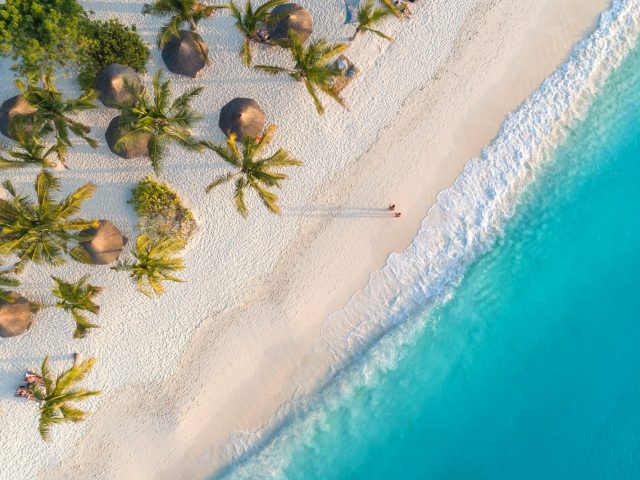
Known as the Spice Island, the beautiful island of Zanzibar on Africa’s east coast is bursting with culture and history, seemingly at odds with its idyllic geography of white-sand beaches with palms swaying lazily in the sea breeze. Together this makes Zanzibar a fabulous place to explore as well as a dream to relax and unwind.

Zanzibar is the semi-autonomous part of Tanzania in East Africa. It is composed of the Zanzibar Archipelago in the Indian Ocean, 25–50 kilometres (16–31 mi) off the coast of the mainland, and consists of many small islands and two large ones: Unguja (the main island, referred to informally as Zanzibar) and Pemba. The capital is Zanzibar City, located on the island of Unguja. Its historic centre is Stone Town, which is a World Heritage Site.

Portuguese invasion and control of the Swahili Coast in the late 16th century ended the golden age of the archipelago, although the Omani Arabs returned to power less than a century later. Today, many of the winding streets and high townhouses of old Stone Town remain unchanged and visitors can walk between the sultan’s palace, the House of Wonders, the Portuguese fort and gardens, the merchants’ houses, and the Turkish baths of the old city. Day-long spice tours to working plantations offer visitors the chance to observe the cultivation of cloves, vanilla, nutmeg, cinnamon, and other spices that have made the island famous.

Zanzibar’s coastline offers some of the best beaches in the world, but sand and surf vary depending on what side of the island you’re on. On the east coast, waves break over coral reefs and sand bars offshore, and low tide reveals small pools of starfish, small minnows, and anemones. Up north, ocean swimming is much less susceptible to the tides, and smooth beaches and white sand make for dazzling days in the sun.

The port city of Stone Town dominates the west coast, and although the beaches of Mangapwani, where slave caves are visible at low tide and nearby Bububu are less than half an hour’s drive away, a night or two spent on the east or north cost is well worth the extra hour it takes to drive there. That said, the Chole Island Marine Park just off Stone Town – and nearby Prison, Grave, and Snake Islands – make a refreshing day-trip and a good break from exploring the winding passageways of the old city.

On the south coast of Zanzibar lies the Menai Bay Conservation Area, a sea turtle protection area for the endangered species that come to breed on the island. Roads to the southeast coast take visitors through the Jozani Forest, home to Zanzibar’s rare Red Colobus monkeys and a number of other primate and small antelope species.

Stretching for 50km along the  base of the rusty-gold 600-metre high Rift Valley escarpment, Lake   Manyara is a scenic gem, with a setting extolled by Ernest  Hemingway as “the loveliest I had seen in Africa”.

The compact game-viewing  circuit through Manyara offers a virtual microcosm of the Tanzanian safari  experience.

From the entrance gate, the  road winds through an expanse of lush jungle-like groundwater forest where  hundred-strong baboon troops lounge nonchalantly along the roadside, blue  monkeys scamper nimbly between the ancient mahogany trees, dainty bushbuck  tread warily through the shadows, and outsized forest hornbills honk  cacophonously in the high canopy.

Contrasting with the intimacy of the forest is the grassy floodplain and its expansive views eastward, across the alkaline lake, to the jagged blue volcanic peaks that rise from the endless Maasai Steppes. Large buffalo, wildebeest and zebra herds congregate on these grassy plains, as do giraffes – some so dark in coloration that they appear to be black from a distance.

Inland of the floodplain, a narrow belt of acacia woodland is the favoured haunt of Manyara’s legendary tree-climbing lions and impressively tusked elephants. Squadrons of banded mongoose dart between the acacias, while the diminutive Kirk’s dik-dik forages in their shade. Pairs of klipspringer are often seen silhouetted on the rocks above a field of searing hot springs that steams and bubbles adjacent to the lakeshore in the far south of the park.

Manyara provides the perfect  introduction to Tanzania’s birdlife. More than 400 species have been recorded,  and even a first-time visitor to Africa might reasonably expect to observe 100 of these in  one day. Highlights include thousands of pink-hued flamingos on their perpetual  migration, as well as other large waterbirds such as pelicans, cormorants and  storks.

About Lake Manyara National Park Size: 330 sq km (127 sq miles), of which up to  200 sq km (77 sq miles) is lake when water levels are high. Location: In northern Tanzania. The entrance gate lies 1.5 hours (126km/80 miles)  west of Arusha along a newly surfaced road, close to the ethnically diverse  market town of Mto wa Mbu.

Getting there  By road, charter or scheduled  flight from Arusha, en route to Serengeti and Ngorongoro Crater.

What to do     Game drives, night game drives, canoeing when  the water levels is sufficiently high. Cultural tours, picnicking, bush lunch/dinner, mountain bike tours, abseiling  and forest walks on the escarpment outside the park.

When to go    Dry season (July-October) for large mammals; Wet season (November-June) for bird watching, the waterfalls and canoeing.

Accommodation       One luxury treehouse-style camp, public bandas  and campsites inside the park. One luxury tented camp and three lodges perched on the Rift Wall outside the  park overlooking the lake. Several guesthouses and campsites in nearby Mto wa Mbu.

Tarangire National Park is located between the meadows of Masai Steppe to the south east and the lakes of the Great Rift Valley to the north and west. Among the rolling area where the park lies, it occupies an area of 2,600 square kilometers. The perennial Tarangire River takes over the northern part of Tarangire. Through the cut ditches, the River flows upwards up to when it leaves the corner of the park, in the North West flowing into Lake Burungi. There are a number of wide swamps which dry into green plains during the dry season in the south.

You are recommended to stay for a few days in the south of the park that is also less crowded and gives you the opportunity to get a real feel of the back country while on your visit to the Tarangire.

Tarangire Attractions

From elephants to lions, find all attractions to see in Tarangire National Park, the most sought after animals as well as adventure safari tips in Tanzania

Getting There

Arusha town is a starting point to many for most of the safaris to this circuit.Tarangire is almost the least visited park among those Tanzanian parks in the North.

When To Visit

The middle and the end of the dry season that runs from late June to October is the best time to view wild life in Tarangire National Park.

Where To Stay

There is a wide selection of hotels from which to choose that suits all your needs in Tarangire National Park, from budget to luxury accommodation.

The Tarangire River is a permanent feature that even shares a name with the Tarangire Park. There are a number of large swamps .These are usually dry for most of the year .The Tarangire is usually very dry ,in fact drier than the Serengeti, however its vegetation is much more green especially with lots of elephant grass, vast areas with mixed acacia woodlands and some of  the wonderful ribbons of the aquatic forest.

The wild animals in this park differ depending on the season. It is also linked to the fact that Tarangire is just a part of the bigger ecosystem. Many of the animals leave the park during the months of November to May. The zebras as well as large herds of wildebeests move into the north-western direction towards the Rift Valley floor amongst the large numbers of animals that spread across the large open areas of the Masaai Steppe. The game goes back to the Tarangire swamps during the dry season around the months of June to October most especially, the river system. This is noted as the best season hence enjoy the best of animal viewing during your safari visit to Tarangire around this time. You will obviously see big numbers of elephants gather here as well as the wildebeests and zebras.
The impalas also exist in large numbers as well, eland, buffalo and giraffes. Bohor reedbuck, Thompson’s gazelle, greater and lesser kudu and the Coke’s hartebeest. On really some rare occasions, the common usual gerenuk and fringe –eared Oryx are also seen. A few black rhinos are also thought to be still present in this park.

Among the other common animals in the Tarangire are the leopards, lions, hyenas, and cheetah that seem to be popular within the southern open areas. The wild dogs are only seen once in a while

The birds within the Tarangire are also quite many, there are over 500 species that have been identified here. The lovebirds that are yellow collared, the shy starlings are in plenty and widespread in Tanzania.

Mainly, the dry open woods like e acacia thickets, as well as many of its significant baobab trees make up the vegetation of the Tarangire. The stunning acacia tortillis trees not forgetting the occasional palm tree. There are also huge flat swamps within the woodlands in the south that get very impassable during the rains. During the rest of the year; they will also uniformly dry in green.

Follow us on

What people say

  • star rating  Well, it's been over a month now since I traveled with Jumanee and his team of super human porters and his excellent chef and every day I think about the... read more

    Jerome P
    October 16, 2019
  • star rating  I'm in the process of climbing the seven summits. I chose these guys for my Kili climb and I must say they exceeded my expectations on every level! The service,... read more

    ngpmiketaylor
    July 5, 2018

Contacts

P.O.Box 365, Hai Bomang’ombe Kilimanjaro – Tanzania

Payment options

©Kili-Boma Adventures 2020 All Rights Reserved